Working from home was supposed to be the simple option. No commute, no rent, no long lease hanging over a business that was still finding its feet. For thousands of Surrey businesses it worked, and for many it still does. But somewhere between the third year of kitchen table calls and the second client meeting held in a coffee shop, a quieter cost starts to show up on the balance sheet.
This is not an argument for dragging everyone back to a desk five days a week. The evidence does not support that, and neither do we. It is an argument for being honest about what home working costs a growing business once it has outgrown it, and for recognising that the alternative is no longer a five year lease and a car park full of empty spaces.
What the numbers actually say
Hybrid working is not going anywhere. According to the Office for National Statistics, more than a quarter of working adults in Great Britain, 28%, hybrid worked between January and March 2025. The CIPD found that 80% of employees say working flexibly has had a positive impact on their quality of life, and that 41% of employers believe home and hybrid working has increased productivity in their organisation, against 16% who believe it has decreased it.
So flexibility works. What has changed is where it happens.
The same CIPD research, published in July 2025, found that 65% of organisations now require employees to be in the workplace a minimum number of days per week or month, and that hybrid working adoption had slipped from 84% in 2023 to 74%. A British Chambers of Commerce survey of 583 businesses, 94% of them SMEs, found 41% had increased their requirement for on site working over the previous year.
Businesses are not abandoning flexibility. They are working out that flexibility needs somewhere to happen.
Five signs your business has outgrown working from home
1. Your client meetings happen in coffee shops
It is a small thing until it is not. A prospective client agrees to meet, and you find yourself scanning for a quiet table, hoping the milk steamer stays silent through the part where you talk about price. You cannot control the noise, the seating, the wifi, or who is sitting close enough to hear your numbers.
The cost here is not the coffee. It is the impression, and the way it quietly caps the size of the deals you feel able to chase.
2. New starters take longer to get up to speed
Onboarding is the part of home working that rarely survives contact with growth. Experienced staff carry the culture in their heads and manage perfectly well from a spare room. New people have nothing to absorb it from except scheduled calls, and nobody schedules a call to explain how things really work here.
Employers consistently report this. The CIPD found the drawbacks employers most often cite are the ability of managers to lead teams effectively, employees' connection to organisational purpose, and organisational culture. Those three things are what turns a new hire into a productive colleague, and they are the three things that thin out fastest at distance.
3. Your best people are lonely, not unproductive
This one is easy to miss, because the work still gets done. Output holds up while something else erodes. Businesses tell researchers they expanded home working to improve staff wellbeing, then name reduced wellbeing through isolation as one of their biggest challenges. Both things are true at once.
The people most affected are often the ones you can least afford to lose: the capable, self sufficient ones who never complain, right up until they hand in their notice for a role with a team attached to it.
4. Your home address is your business address
Every company registration, every invoice, every website footer carries it. It works fine when you are one person testing an idea. It works less well when you are pitching against competitors with a commercial address, when a supplier wants to know how established you are, or when you would rather not have your home postcode publicly searchable.
A professional business address is one of the cheapest credibility upgrades available to a small business, and one of the last ones people get around to.
5. The admin has quietly become someone's second job
Broadband contracts across six households. Laptops nobody can physically get hold of when they fail. Insurance and health and safety obligations that do not disappear because the desk is in a bedroom. Somebody, usually the founder, absorbs all of this in the evenings.
Running a business shouldn't feel like running a facilities department as well. That was the original promise of home working, and at a certain size it stops being kept.
The false choice
Here is where most businesses get stuck. The options appear to be carry on as you are, or commit to a conventional lease with a rent deposit, a dilapidations clause, and a term measured in years. One feels like standing still. The other feels like betting the company on a growth forecast.
It is a false choice, and it has been for some time. The middle ground is space you can take for as long as you need it and hand back when your needs change, with the facilities of a proper office and none of the liabilities of owning one.
What that looks like at Robert Denholm House
At TLP Workspace, we deliberately offer more than one answer, because businesses arrive at this point from different directions.
If your team needs somewhere to be together, our serviced offices are move in ready on three month rolling agreements. Utilities, communal cleaning, high speed internet and on site parking are included in one monthly fee, so you can take more space as you grow or scale back if you need to, without a long term commitment.
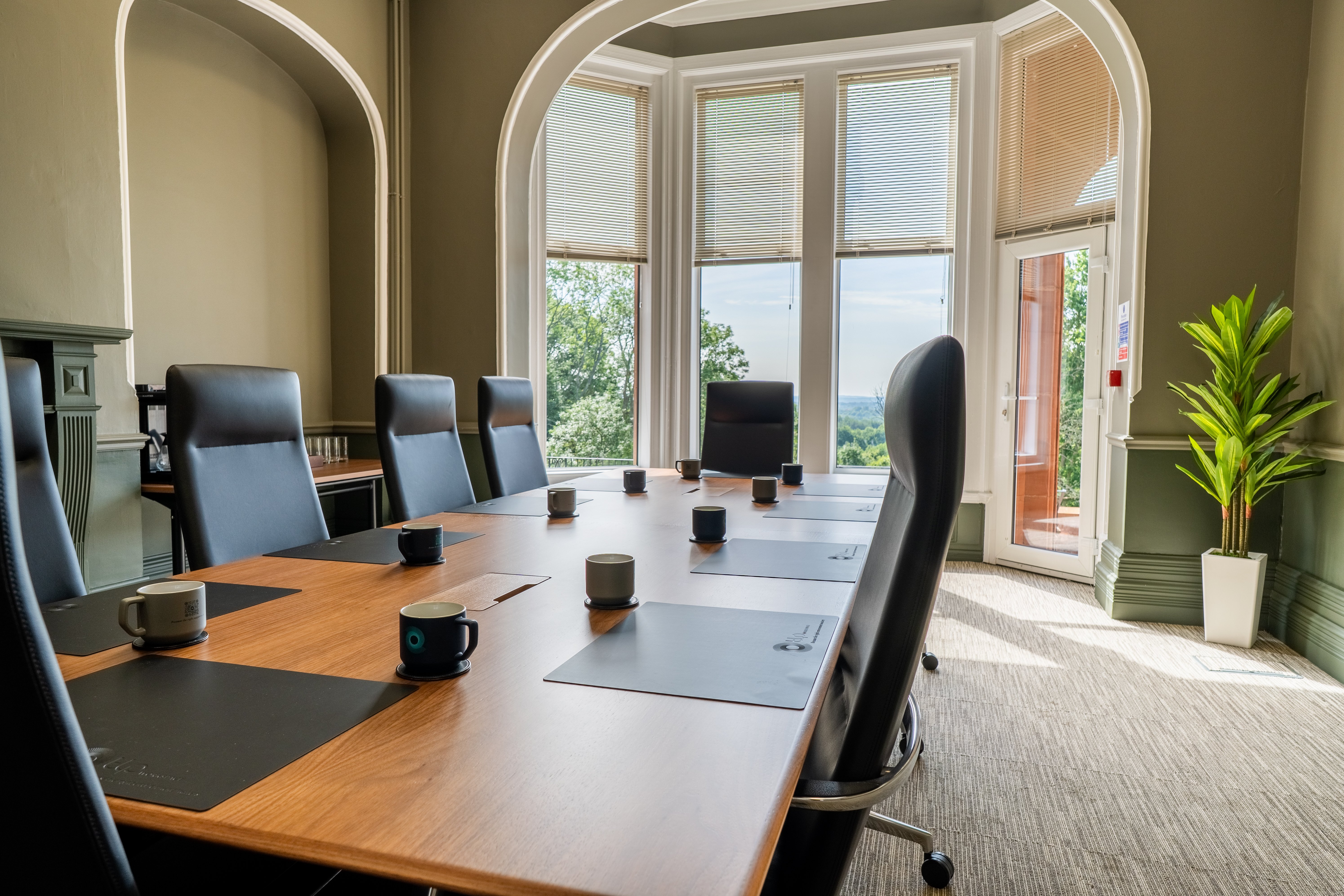
If you mostly work from home and simply need somewhere credible to meet people, our meeting rooms and boardrooms can be booked by the hour, half day or full day. Client meetings, interviews, training sessions and team workshops, in a room you control, with free parking for your visitors.
And if what you actually need is a professional business address rather than a desk, a virtual office gives you that without changing how your team works day to day.
Robert Denholm House is a historic country house set in 27 acres of landscaped grounds in Nutfield, Surrey, well connected to London, Gatwick Airport and the wider South East. It is the kind of setting that makes a team glad they came in, and makes a client remember the meeting.
As your business grows, so does what it needs. Through the wider TLP group we can also help with managed IT services, recruitment and workforce support, so you are not starting a new supplier search every time something changes. We are there for the duration, not just the transaction.
Come and have a look
If two or three of those five signs sounded familiar, it is probably worth an hour of your time to see what the alternative looks like in practice. Nothing about a visit commits you to anything.
Book a tour of Robert Denholm House, or call us on 01737 824000. We will show you the offices and meeting rooms available, talk honestly about what would suit the way you actually work, and if the answer is that you are fine as you are, we will tell you that too.
Because the right environment matters.